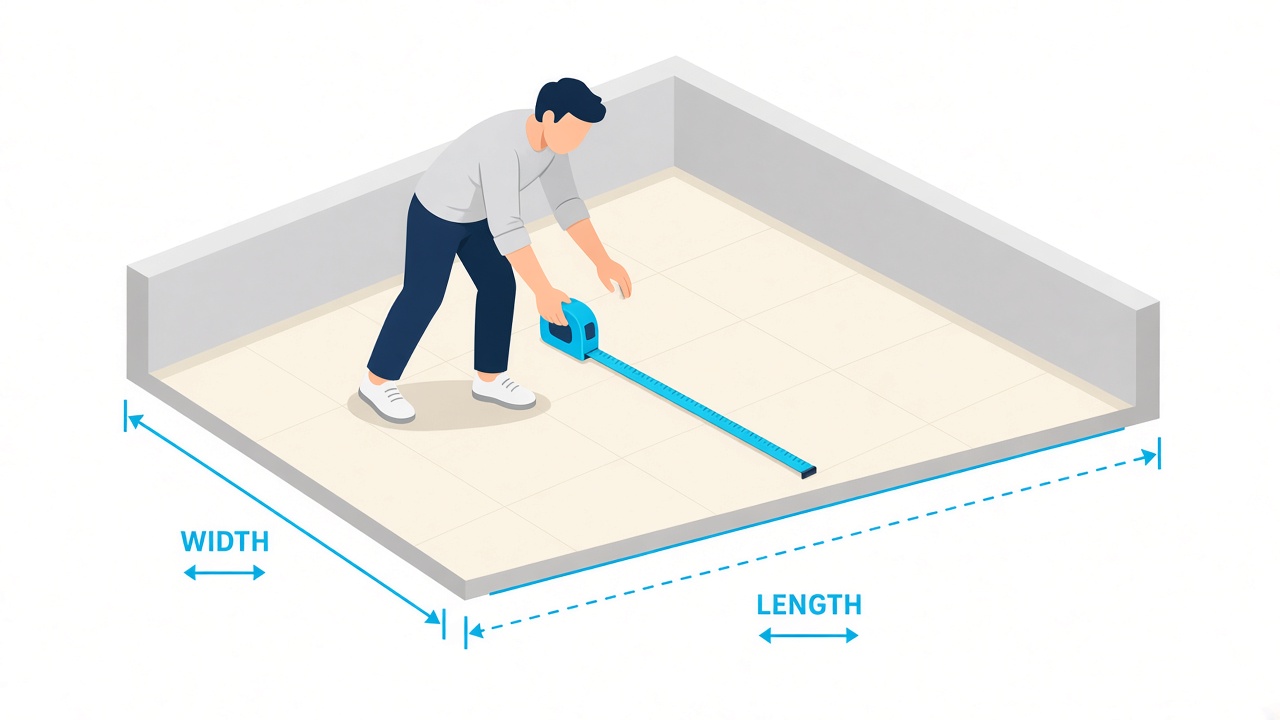
How to Measure Square Footage (Any Room, House, or Space)
To measure square footage, multiply length by width for a rectangular space. A room 12 feet by 10 feet is 120 square feet. For an irregular space, divide it into rectangles, measure each, and add the areas. Square footage is a measure of area, written in square feet (ft²), and equals length times width.
This guide is the method reference for every square footage case, from a single room to a whole house, a roof, a yard, or a flooring order. Each specific job links out to a dedicated calculator. Run the numbers in the Square Footage Calculator after you finish measuring.
What Is Square Footage?
Square footage is the area of a two-dimensional space, measured in square feet (ft²). Area answers how much flat surface a space covers, and for a rectangle it equals length times width. A square foot is a square that measures one foot on every side.
Square footage relates to other area units by fixed conversions. The table below lists the equivalences used throughout this guide.
| Unit | Equivalent in square feet |
|---|---|
| 1 square inch | 1/144 ft² (144 in² = 1 ft²) |
| 1 square yard | 9 ft² |
| 1 square meter | 10.764 ft² |
| 1 acre | 43,560 ft² |
These values convert any area into or out of square feet. One square yard holds 9 square feet, and one acre holds 43,560 square feet. Large areas convert to acres by division, and small areas convert to square inches by multiplication. Listings in metric markets often report square meters, while carpet suppliers often quote square yards.
The Square Footage Formula
The square footage formula is Square footage = length × width. Measure both the length and the width in feet, then multiply them. A space 15 feet long and 12 feet wide covers 15 × 12 = 180 square feet.
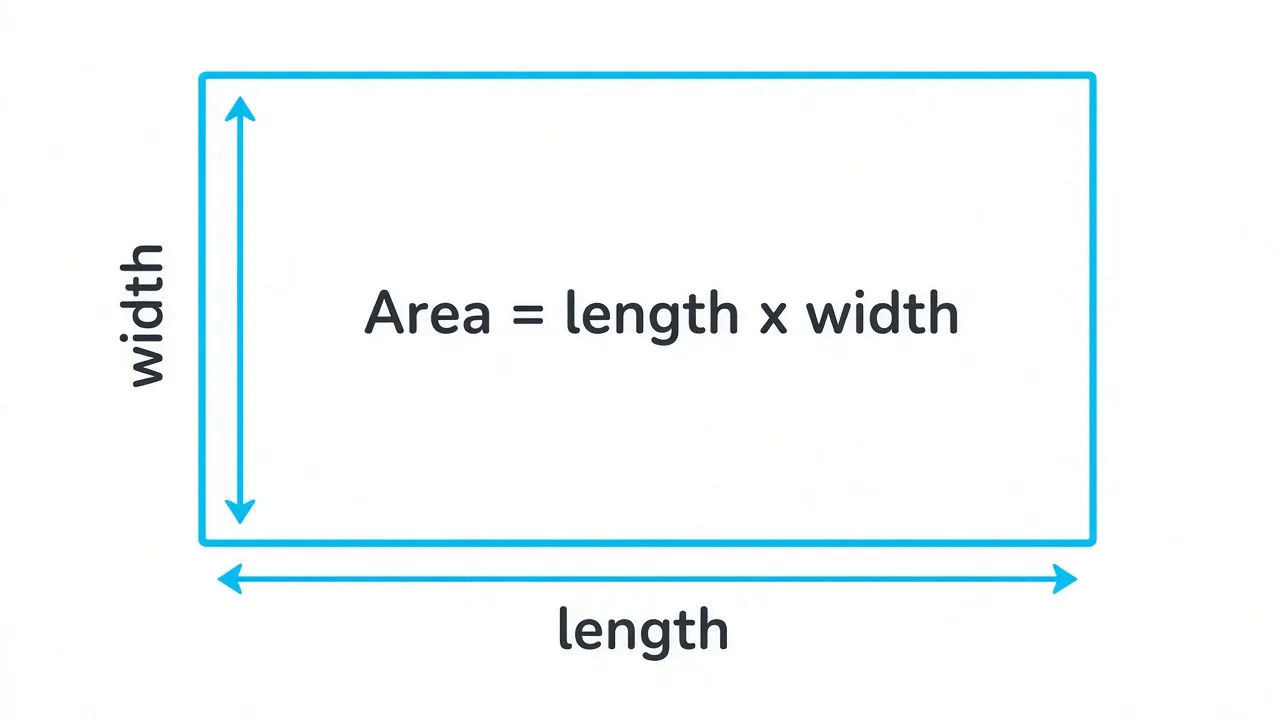
Keep both measurements in feet before multiplying. A dimension taken in inches converts to feet by dividing by 12, so a wall measured at 150 inches becomes 12.5 feet. Multiplying a length in feet by a width in inches mixes two units and returns a wrong result, which is the most common measurement error.
When a space has more than one rectangle, apply the formula once per rectangle, then add the areas. The same length × width rule feeds every later conversion to square meters, square yards, or acres.
How to Measure Square Footage Step by Step
Measure the square footage of a space in 5 steps:
- Measure the longest wall in feet to find the length, using a tape measure or a laser measure.
- Measure the width in feet, perpendicular to the length.
- Multiply the length by the width to get the area in square feet.
- For a space made of several areas, repeat the measurement for each and add the areas together.
- Subtract any area you will not cover, such as a fixed island or a built-in cabinet.
A laser measure reads a long wall faster and more accurately than a tape pulled across furniture, while a tape measure suits short runs and tight corners. Measuring each wall twice catches the small reading errors that shift an area total.
Write every dimension in feet and tenths of a foot before you multiply. A note that says “12 ft 6 in” should become 12.5 before it enters the formula, so the product stays in square feet rather than a mixed-unit figure that no supplier can use.
How to Measure an Irregular or Odd-Shaped Room
Measure an irregular room by dividing it into rectangles and triangles, calculating each section, then adding the sections. A rectangle is length × width, and a triangle is ½ × base × height. Breaking a complex floor into simple shapes turns one hard measurement into several easy ones.
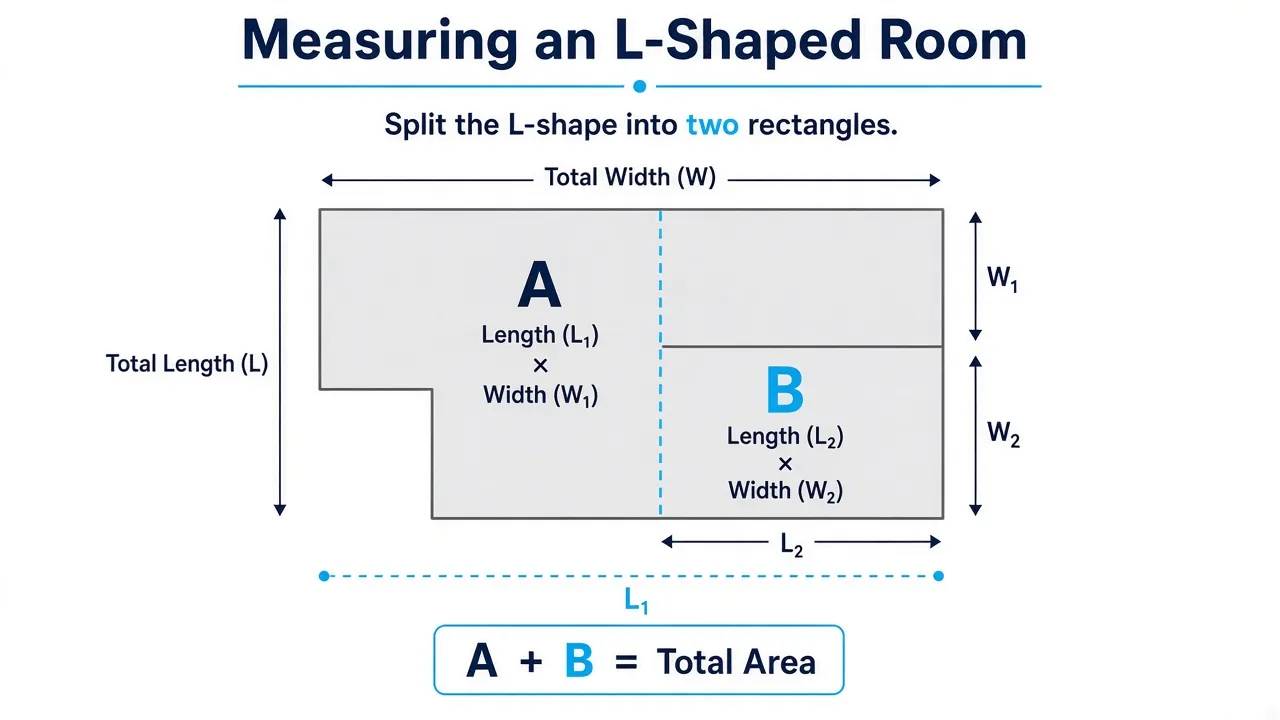
An L-shaped room splits into two rectangles along the inside corner. A room with a first rectangle of 12 feet by 10 feet and a second of 8 feet by 6 feet covers 120 + 48 = 168 square feet. Add every section for the room total, and use the irregular shape calculator when a floor has many sections or an angled wall.
For a curved bay or a clipped corner, fit the nearest rectangle or triangle that covers the usable floor, then add that section to the total. Overestimating a curved edge by a few square feet is safer than underestimating when the total feeds a material order.
How to Measure Square Footage for Different Spaces
The measurement method changes slightly by the kind of space. Each case below has a dedicated calculator for the exact numbers.
A Room
Measure a single room as length × width in feet. A rectangular room is one multiplication, and a room with an alcove adds the alcove as a small rectangle. Keep the method brief here and open the room calculator for the dedicated room tool, including several rooms at once.
A Whole House
Measure a whole house floor by floor, then add the floors. House square footage counts finished, above-grade space, so the garage and an unfinished basement stay out of the living-area total. What counts as square footage for listings follows finished, heated, enclosed rules. The house calculator totals the floors, and the guide on how to calculate the square footage of a house covers the living-area include and exclude list in detail.
Flooring or Tile
Measure the floor area, then add about 10 percent for waste from cuts and pattern matching. A 200-square-foot room needs about 220 square feet of flooring ordered. The flooring calculator and the tile calculator apply the waste factor and convert the area into boxes. The guide on how much flooring you need walks through waste ranges and box math.
A Circle or Round Patio
Measure a circular space with the area formula π × r², where r is the radius, the distance from the center to the edge. A round patio with a 6-foot radius covers 3.1416 × 6² = 113 square feet. The circle calculator computes the area from a radius or a diameter.
A Yard or Piece of Land
Measure a yard in feet for a small plot, then convert large areas to acres by dividing by 43,560. A lot of 87,120 square feet equals 2 acres. The yard calculator sizes a yard, and the acres calculator converts square feet to acres for land.
A Roof
Measure a roof by multiplying the building footprint by a slope factor for the pitch, because a sloped roof holds more surface than the flat area beneath it. A steeper pitch carries a larger slope factor. The roof calculator applies the slope factor for a given pitch.
How to Measure Square Footage With a Phone or Google Maps
A phone can estimate square footage two ways. Laser and augmented-reality apps use the camera to estimate a room’s length and width. Google Maps measures the area of a lot or piece of land by tracing its outline on the map. Both return a usable estimate in seconds.
An app estimates rather than measures exactly, so the reading drifts with camera angle, lighting, and clutter. Confirm any figure that affects a purchase, a listing, or a permit with a tape measure or a laser measure, because a small percentage error on a large area becomes many square feet.
Phone estimates work best as a first pass. After the app returns a rough length and width, remeasure the critical walls with a tape, then recalculate the area with the length × width formula so the final number matches a physical reading.
Converting Square Footage to Other Units
Convert square footage to another area unit with one operation each:
- Square feet to square meters: multiply by 0.0929. A 500-square-foot room is about 46.5 square meters.
- Square feet to square yards: divide by 9. Carpet is often priced by the square yard, converted by the square yards calculator.
- Square feet to acres: divide by 43,560, handled by the acres calculator.
Each conversion runs from a single square-foot figure, so a space measured once converts to every other unit without remeasuring. Metric-market listings use square meters, carpet suppliers use square yards, and land records use acres.
To reverse a conversion, divide square meters by 0.0929 to return to square feet, or multiply square yards by 9. Keep the original measured area in square feet as the source of truth so every unit stays consistent.
Common Square Footage Mistakes
Four mistakes distort a square footage result:
- Measuring in inches without converting to feet before multiplying, which inflates the area.
- Forgetting to add closets, alcoves, and hallways that belong to the space.
- Not subtracting areas that will not be covered, such as a fixed island in a flooring estimate.
- Confusing area with perimeter, reporting the distance around a room (ft) instead of the surface inside it (ft²).
Area and perimeter answer different questions: area is length times width in square feet, and perimeter is the sum of the sides in feet. Checking which one a job needs prevents the most confusing error, because the two numbers are never interchangeable.
A fifth check is unit consistency across rooms. Mixing feet on one floor and meters on another before adding totals produces a figure that no calculator can repair without remeasuring.
Frequently Asked Questions
What is the formula for square footage?
Square footage equals length times width. Measure both in feet, then multiply. A 12-by-10-foot room is 120 square feet.
How do you measure square footage?
Measure the length and width of the space in feet and multiply them. For an irregular space, divide it into rectangles, measure each, and add the areas.
How do I measure the square footage of an irregular room?
Divide the room into rectangles and triangles, calculate each area, then add them. A rectangle is length × width; a triangle is half the base times the height.
How many square feet is a 12x12 room?
A 12-by-12-foot room is 144 square feet (12 × 12).
Can I measure square footage with my phone?
Yes. Laser and augmented-reality apps estimate room dimensions, and Google Maps measures land area. Confirm important measurements with a tape measure.
How do I convert square footage to square meters?
Multiply square feet by 0.0929. A 500-square-foot room is about 46.5 square meters.
Conclusion
To measure square footage for any space, measure length and width in feet, multiply for a rectangle, and add sections for an irregular or multi-part area. The method is the same from a single room to a whole house, with a waste factor for flooring and a unit conversion for land. Run the numbers for your exact case in the Square Footage Calculator.
blog.ctaIntro Square Footage Calculator.