What Counts as Square Footage in a House?
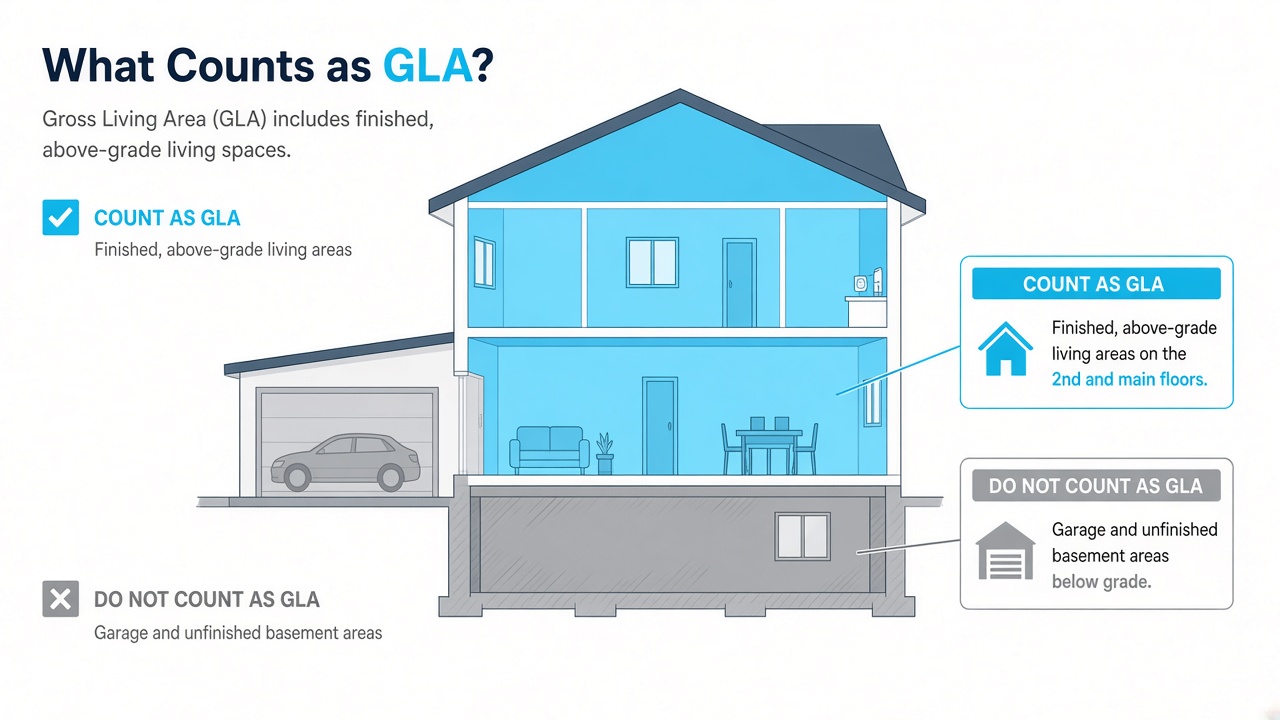
Square footage counts finished, heated living space that is above ground level. Under the ANSI Z765 standard, an area must be finished, permanently heated, and have a ceiling at least 7 feet high to count as gross living area (GLA). Garages, unfinished basements, and open-to-below spaces do not count.
The rules matter because the same house can carry different square footage numbers on a listing, a tax record, and an appraisal. This guide sets out what ANSI Z765 counts and excludes, why a finished basement is treated separately, and why the figures disagree across sources. To add up the finished space in your own home, use the House Square Footage Calculator.
What Square Footage Actually Means
Square footage in real estate means gross living area (GLA), the finished, heated, above-grade living space of a house. GLA is measured to ANSI Z765-2021, the current version of the American National Standards Institute method titled Square Footage: Method for Calculating. This standard is the one appraisers apply, and Fannie Mae made it required for single-family appraisals in April 2022, with Freddie Mac following.
GLA is not the same as total floor area. A house has finished and unfinished space, above-grade and below-grade levels, and heated and unheated rooms, and only the space that meets every ANSI rule counts toward the living-area figure. The standard exists so that two appraisers measuring the same house arrive at the same number.
The 4 Rules for Counting Square Footage
An area counts as square footage under ANSI Z765 when it meets all 4 rules:
- It is entirely above grade, with no part of the level below ground level.
- It is finished, with walls, floors, and ceilings completed to the quality of the rest of the house.
- It is permanently heated by a fixed system such as forced-air, radiant, solar, or a ductless unit, not a portable space heater.
- It has a ceiling at least 7 feet high and is accessible from the interior of the home.
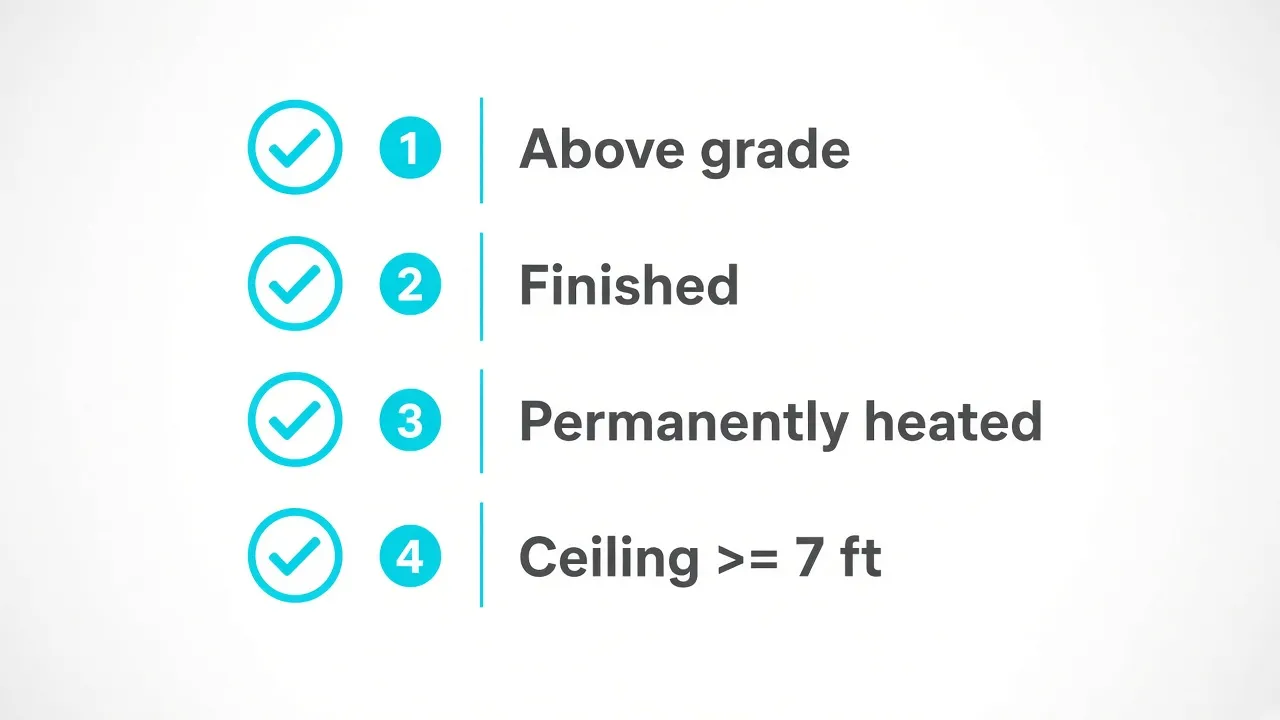
If all four rules are true, the area counts toward GLA. If even one is false, ANSI Z765 excludes it from the living-area figure, though an excluded area such as a finished basement may still be measured and reported separately. The four-rule test applies to every room before it joins the total.
What Counts Toward Square Footage
Finished, above-grade rooms make up the bulk of GLA. Bedrooms, living rooms, the kitchen, and finished bathrooms count, and so do closets, built-ins, and hallways within the finished space. These areas are the standard living spaces a buyer walks through.
Three cases count when they meet the rules. A finished attic counts when it satisfies the ceiling rule below. A finished room above a garage counts when it is above grade, finished, heated, and interior-accessible. Staircases count on the floor they descend from, covered in detail below. Each still has to pass the four-rule test to join the total.
What Does Not Count Toward Square Footage
Several common spaces are excluded from GLA under ANSI Z765, regardless of how well finished they are:
- The garage, whether attached or detached, because it is unfinished living space.
- Unfinished basements and unfinished attics.
- Open-to-below foyers and atriums, because the floor area is open rather than usable.
- Porches, decks, patios, and balconies, unless fully enclosed, heated, and finished to the home’s standard.
- Detached accessory dwelling units, guest houses, and sheds, which are separate structures.
- Any area with a ceiling under 5 feet.
These areas may add value and may be reported on a listing, but they are not part of the living-area figure. A finished detached guest house, for example, is described separately rather than folded into the main house GLA. A sunroom sits on the boundary: it counts only when it is finished, above grade, and heated by the home’s permanent system to the same standard as the rest of the house, and it stays out when it is unheated three-season space.
Does a Finished Basement Count as Square Footage?
No. Under ANSI Z765, a finished basement is excluded from gross living area because it is below grade, even when it is fully finished to a high standard. It is measured and reported separately as finished below-grade area, and it still adds real value to the home. The exclusion is about classification, not quality.
The grade line creates a gray zone in some house styles. In a bi-level, a raised ranch, or a walkout, part of a level often sits below grade on one wall. ANSI Z765 treats the entire level as below-grade area when any portion is below grade. Local MLS rules, county assessors, and lenders vary in how they present below-grade finished space, so a listing may show a combined total while an appraisal separates it. A quick check of which figure a source reports prevents a false comparison.
How Stairs and Sloped Ceilings Are Counted
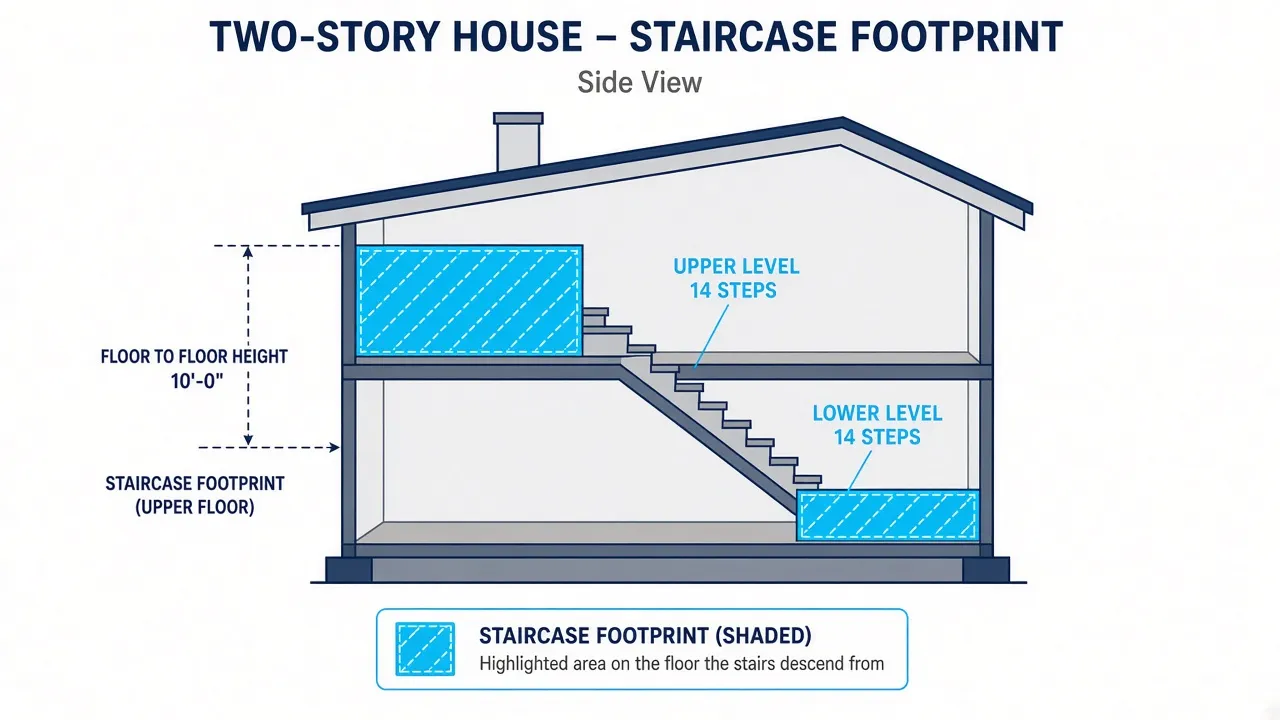
Stairs count as square footage on the floor they descend from. In a two-story house, the staircase opening counts on both the upper and lower floors, because each floor loses that footprint to the stairwell. The area under the stairs counts on the lower level, and ANSI Z765 limits the counted stair area to the size of the floor opening.
Sloped ceilings follow a specific rule. At least 50 percent of the finished floor area must have a ceiling of at least 7 feet, and no area with a ceiling under 5 feet counts at all. A Cape Cod or a finished attic with knee walls therefore loses the low-headroom strips along the edges, and only the taller center of the room joins GLA. One narrow exception applies: under a beam or another obstruction, ANSI Z765 allows a reduced height of 6 feet 4 inches for that spot rather than the full 7 feet. The ceiling rule is the most common reason a measured figure comes in below an owner’s expectation.
How Square Footage Is Measured
Appraisers measure the square footage of a detached house from the exterior walls, so the wall thickness is included in the footprint rather than carved out. A condominium or apartment is measured to the interior finished space instead, because the owner does not hold the exterior walls. The measurement method depends on the property type.
ANSI Z765 sets the precision. Dimensions are taken to the nearest inch, or the nearest tenth of a foot, and the final square footage is reported to the nearest whole square foot. Exterior measurement is why an interior tape measurement of the same house runs smaller: it omits the wall thickness that the ANSI method includes.
Why Zillow, Tax Records, and Appraisals Disagree
Three sources report house square footage, and they often disagree. Listing portals such as Zillow and Redfin pull county assessor records, which vary in how they treat basements and are frequently outdated. A county tax assessor measures for taxation rather than to ANSI, and the record may not reflect a renovation. A licensed appraiser measuring to ANSI Z765 produces the most consistent figure.
The practical step is to check the source behind any square footage number before relying on it. A portal figure is a starting point, an assessor figure is a tax record, and an ANSI appraisal is the measurement a lender accepts. When the numbers matter for a sale or a loan, an independent measurement to ANSI Z765 settles the difference. The guide on how to measure square footage covers the method, and how to calculate the square footage of a house covers totaling the finished floors.
Frequently Asked Questions
What counts as square footage in a house?
Finished, heated living space above ground level counts. Under ANSI Z765, the area must have a ceiling at least 7 feet high. Garages and unfinished basements do not count.
Does a finished basement count as square footage?
No. Under ANSI Z765, a finished basement is excluded from gross living area because it is below grade. It is reported separately as finished basement area.
Does a garage count as square footage?
No. A garage is unfinished and unheated, so it never counts toward a house’s living square footage.
Do stairs count as square footage?
Yes. Stairs are counted in the square footage of the floor they descend from. In a two-story house, the staircase footprint counts on both floors.
What is gross living area (GLA)?
Gross living area is the finished, heated, above-grade space of a house, measured to the ANSI Z765 standard. It excludes basements, garages, and unfinished areas.
Why is my house square footage different on Zillow and the tax record?
Zillow pulls county assessor data, which varies on basements and is often outdated. An appraiser measuring to ANSI standards gives the most accurate figure.
Do you measure square footage from the inside or the outside?
For a detached house, appraisers measure the exterior walls. For a condominium or apartment, they measure the interior finished space.
Conclusion
What counts as square footage is settled by one test: finished, heated, above-grade space with a ceiling of at least 7 feet, measured to ANSI Z765. A finished basement, a garage, and an open porch stay out of gross living area even when they add value, and stairs count on the floor they descend from. When you know which spaces qualify, add up your finished floors with the House Square Footage Calculator.
Sources
American National Standards Institute. ANSI Z765-2021, Square Footage: Method for Calculating (published by Home Innovation Research Labs). Fannie Mae adopted ANSI Z765-2021 as required for single-family appraisals effective April 2022.
blog.ctaIntro House Square Footage Calculator.